 Lei Li
Quick Navigation
I've been guiding tours in China for over a decade, and every year the rules shift. One thing remains constant: the digital entry maze. You book a flight, get a visa, then land and realize your international card won't work, or you need a Chinese phone number to reserve the Great Wall. Let me save you that headache.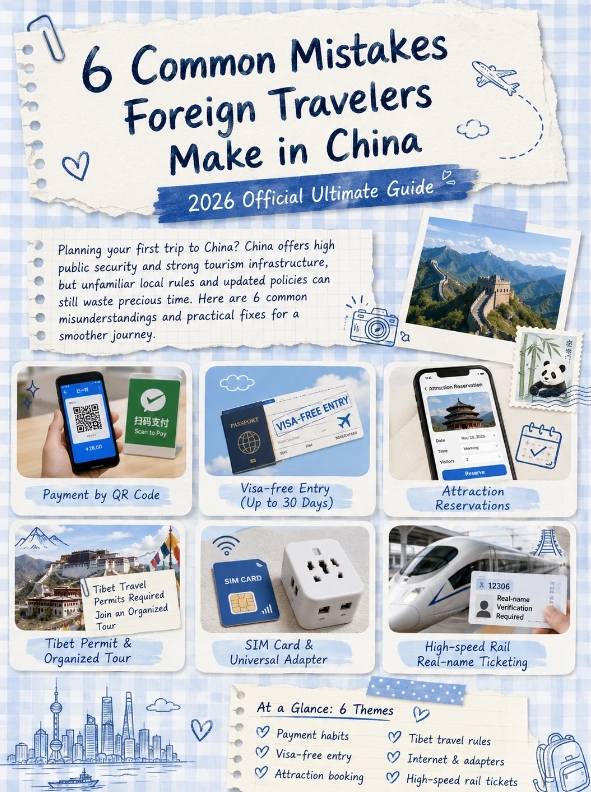
Visa Updates & Entry Requirements
China reintroduced unilateral visa-free entry for citizens of France, Germany, Italy, Netherlands, Spain, Malaysia, Singapore, and a few others—but only for stays up to 15 days. If you're from a country not on the list, you still need a tourist visa (L visa). Apply at least 4 weeks ahead. The Chinese embassy now requires online application forms uploaded via their portal — no paper copies accepted.
| Nationality | Visa-Free? (2026) | Max Stay | Special Notes |
|---|---|---|---|
| France, Germany, Italy, Netherlands, Spain, Malaysia, Singapore | Yes | 15 days | Must enter for tourism/business, passport valid 6+ months |
| USA, UK, Canada, Australia, Japan, South Korea | No | L visa up to 30 days (single/double entry) | Invitation letter not required for standard L visa |
| Other countries | Check embassy website | Varies | Some eligible for 24-hour transit without visa (TWOV) |
Here's the catch: Even with visa-free, you must register your accommodation with local police within 24 hours. Hotels do this automatically. If you stay in an Airbnb, you or the host must do it — most hosts don't bother, and you'll be fined ¥500–2000 upon departure.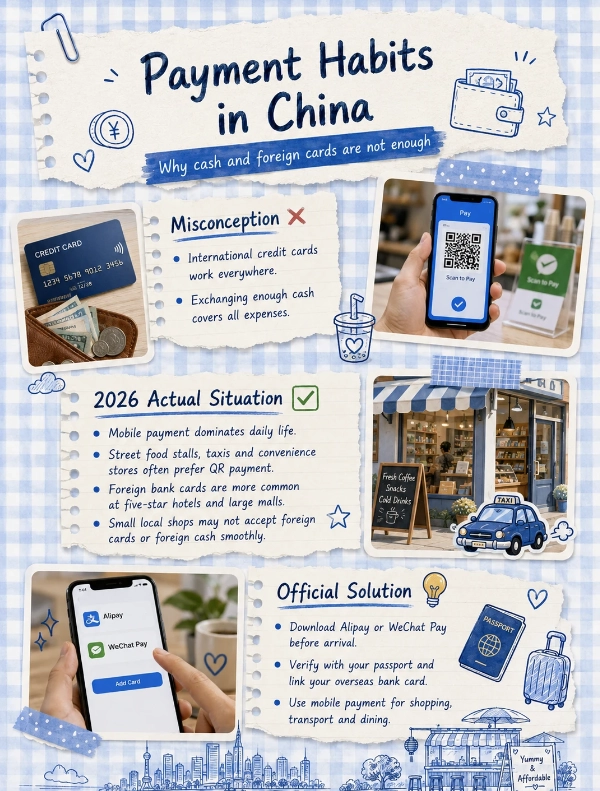
Digital Essentials: Payments, Maps & VPN
Payments
Cash is rarely accepted in major cities — noodle shops, subway kiosks, even some taxis only take mobile payments. I coach every client: link your foreign credit card to Alipay (tourist version allows Mastercard/Visa) before departure. WeChat Pay also works but needs a Chinese bank card for some functions. For your first week, carry ¥500–1000 in cash for emergencies. ATMs at Bank of China usually accept foreign cards but charge a fee.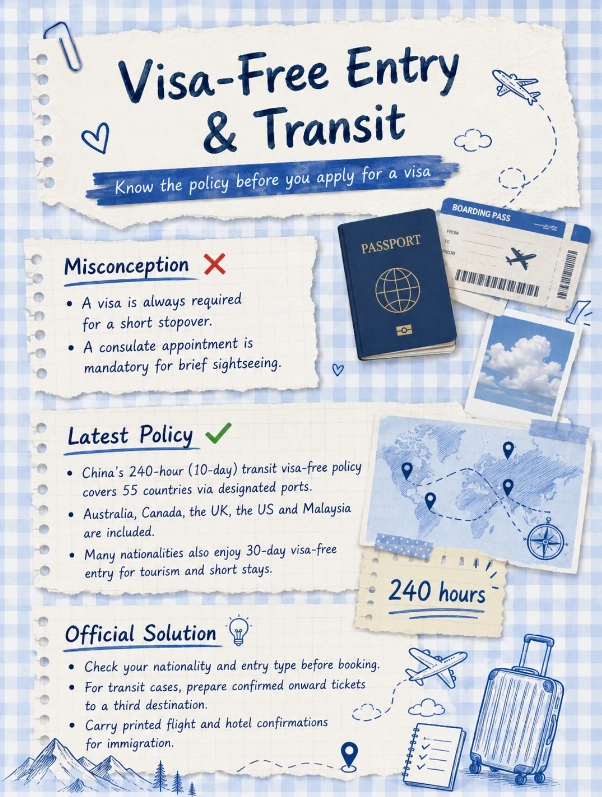
Maps
Google Maps is blocked and inaccurate in China. Instead, install Apple Maps (works decently with English names) or use Amap in English mode. But my go-to for directions: Didi (DiDi Global) app — it's like Uber and accepts Alipay. Always have the Chinese address written down to show the driver. For example, if heading to the Forbidden City, write: 故宫博物院 (Gùgōng Bówùyuàn).
VPN
China blocks Google, WhatsApp, Instagram, Facebook, and many news sites. You must have a VPN installed before your flight — after landing, you can't download one. I personally use ExpressVPN or Astrill; they've been reliable. Free VPNs often fail. Test it in your hotel WiFi as soon as you arrive.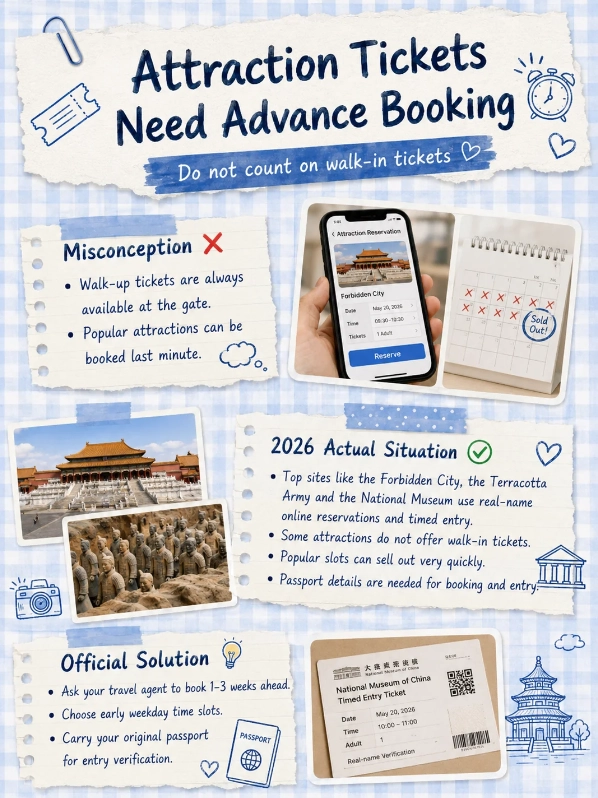
Booking Attractions & Train Tickets
Most major attractions require advance reservation with your passport number. The official WeChat mini-program is the common method, but navigating it in Chinese is a nightmare. For foreigners, I recommend Trip.com (formerly Ctrip international) — they handle Forbidden City, Great Wall, Shanghai Disney, and many museums. You pay in your own currency, and they issue e-tickets linked to your passport.
High-speed trains: Book via Trip.com or at the station (bring passport). For popular routes like Beijing–Shanghai, book 14 days ahead. The ticket office at major stations has a foreigner window — look for “外国人” sign. Show your passport and the train number. Payment: cash or Alipay.
| Attraction | Ticket Price (2026) | Reservation Needed? | Foreigner-friendly booking |
|---|---|---|---|
| Forbidden City (Beijing) | ¥60 (Apr-Oct) / ¥40 (Nov-Mar) | Yes, at least 7 days ahead | Trip.com or official website (English) |
| Mutianyu Great Wall | ¥45 (adult) + shuttle ¥15 | Yes, 1 day ahead | Trip.com or on-site (long queue) |
| Shanghai Disneyland | ¥475 (peak) / ¥399 (regular) | Yes, up to 30 days | Official app (English) or Trip.com |
| Xi’an Terracotta Warriors | ¥120 | Yes, 1 day ahead | Trip.com or on-site (passport needed) |
Common Pitfalls Foreigners Face
1. WeChat mini-programs in Chinese: Even the English version of many mini-programs is broken. I always tell my group: “Don't fight the mini-program alone. Ask your hotel front desk to help you book.” Most hotel staff will do it for you.
2. Tipping culture: Tipping is not expected in China. In restaurants, the bill includes service. Leaving cash on the table might confuse staff. I once had a waitress chase me down to return ¥10 tip.
3. Cash refusal: In 2026, many small shops and street vendors still prefer cashless. But by law, they must accept cash. If a taxi driver refuses, show them the law on your phone — actually, just switch to Didi.
4. Public toilets: Bring your own toilet paper and hand sanitizer. Many restrooms are squat toilets (especially at tourist sites) and have no paper. I always carry a small pack in my day bag.
FAQ
Verified and fact-checked by the editorial team. This content has been fact-checked to ensure informational precision.








Had high hopes because the title says '2026', but some details feel recycled from last year. For example, it still lists quarantine for certain regions when that policy changed in late 2025. Got confused while cross-referencing with official sources. Needs a proper fact-check before I'd rely on it.
Good overview for 2026 planning, especially the section on business visa extensions. However, the health declaration part seems a bit outdated — it still mentions PCR tests that were dropped last month. Still useful overall, just needs a quick refresh on the latest updates.
Spot on about the transit visa waiver rules and the mandatory pre-arrival registration. I used the tips to navigate a layover in Shanghai without any hiccups. The step-by-step for the online declaration app was exactly what I needed. Five stars for practical, no-fluff info.
I was stressing about taking my elderly parents to China next spring, but this article laid out exactly what we need for visa applications and quarantine exemptions. The timeline checklist is gold. Highly recommend for anyone traveling with family — it’s thorough and easy to follow.
This guide saved me hours of digging through official websites. It breaks down the 2026 entry rules, visa categories, and even the new digital health form in a super clear way. As a solo traveler planning a three-week trip, I finally feel confident about what documents to prepare. Absolute lifesaver.
It's okay as a starting point, but I felt the information was a bit stale. The title says '2026' yet most references seem pulled from late 2025 policies. Also missing any emergency procedures — like what to do if your test results get delayed at the border. I'd use it to get a general idea, but definitely double-check with official sources before you travel. Needs an update.
Very helpful overview for anyone planning a trip to China in 2026. Covered the major points like visa requirements, test windows, and QR code systems. The reason I'm giving it 4 stars instead of 5 is that it glosses over some provincial-level quirks — for example, the extra forms needed when entering Yunnan or Xinjiang aren't mentioned. Still a solid resource, especially for beginners.
Honestly, I was dreading the paperwork for my 2026 China trip until I stumbled upon this article. It not only listed all the restrictions but also gave practical advice like which apps to pre-install and how to fill out the health declaration form without errors. Followed every tip and got my visa approved in five days. Can't thank the author enough — a must-read for first-time visitors to China!
As someone who flies between Shanghai and San Francisco every other month, I've read a ton of these restriction summaries. This one stands out because it actually includes the latest vaccine recognition rules and quarantine hotel booking tips that most official websites still haven't explained clearly. The writing is straightforward and the links to real government portals are a nice touch. Five stars — please keep it updated.
This guide saved my trip planning! I was totally overwhelmed by all the changing entry rules for China in 2026, but this article broke everything down step by step. The sections on the new health declaration app and visa-free transit updates were exactly what I needed. I even printed out the checklist and it got me through customs without a hitch. Absolute lifesaver — highly recommend to anyone heading to China this year.