 Yan Zhou
Quick navigation: what really matters
You just landed at Shanghai Pudong. The queue moves fast. Then the immigration officer asks for your visa — and you freeze. That happened to a client of mine last year. He thought 144 hours meant six full days (it doesn’t). The 240-hour visa-free transit policy is a game-changer for many nationalities, but one wrong step and you’re buying a last-minute flight out.
After guiding dozens of groups through Chinese immigration, I’ve seen every mistake. Here is the unfiltered truth: the policy sounds straightforward but the devil is in the details — like which airports count, which countries qualify, and how to prove you’re really transiting. Stick with me, and I’ll walk you through the exact steps to get through without a headache.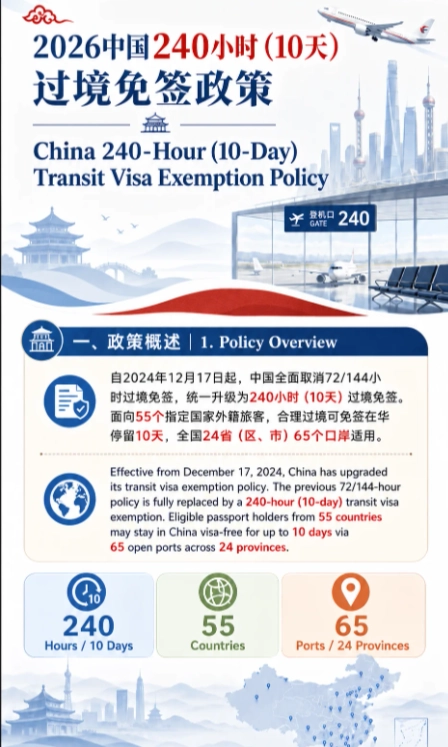
What Exactly Is the 240-hour Visa-free Transit Policy?
Launched to boost short-term travel and business visits, the 240-hour visa-free transit allows citizens of 54 countries (as of policy update) to enter and stay in designated areas of China for up to 10 days — without applying for a visa in advance. You must be transiting to a third country or region (not your home country directly). The clock starts ticking from midnight after your arrival, not from the moment you land. That’s a crucial distinction: if you arrive at 11 p.m., you still count as day one the next morning.
The policy applies to specific ports of entry and exit across China. For example, you can fly into Shanghai, Beijing, Guangzhou, Chengdu, Xi’an, Kunming, and many others. But you cannot wander anywhere in China — your movement is restricted to the administrative region of the entry port (e.g., Shanghai municipality, Jiangsu province, Zhejiang province for Shanghai entry).
Who Can Use the 240-hour Visa-free Transit?
Eligibility depends on your nationality and your itinerary. The list includes most European countries, the US, Canada, Australia, New Zealand, Japan, South Korea, Singapore, and others. Check the official list on the National Immigration Administration website (nia.gov.cn) or ask your airline before booking.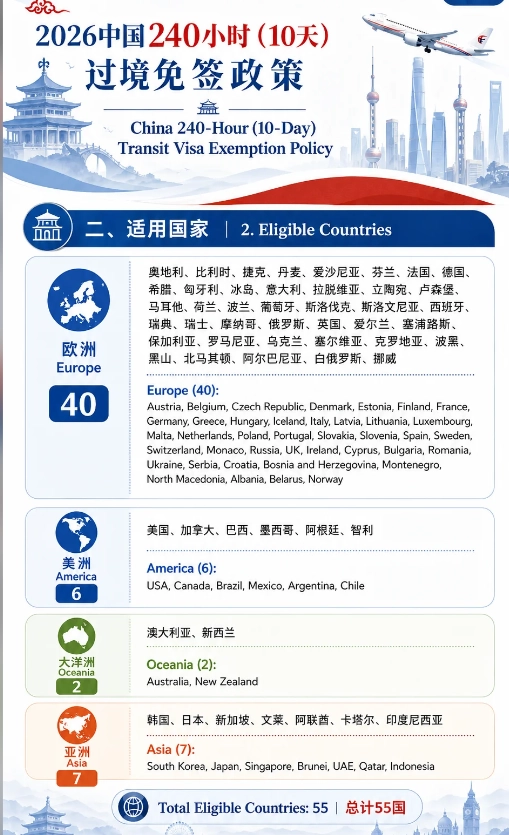
| Region | Example Eligible Countries |
|---|---|
| Europe | UK, Germany, France, Italy, Spain, Switzerland, Netherlands, Russia, etc. |
| Americas | USA, Canada, Brazil, Argentina, Mexico |
| Asia & Oceania | Japan, South Korea, Singapore, Australia, New Zealand |
| Middle East | UAE, Qatar, Saudi Arabia |
But having a qualifying passport isn’t enough. You must hold a confirmed onward ticket to a third country (or region like Hong Kong, Macau, Taiwan) within 240 hours. The ticket can be any mode of transport — flight, train, or ship — but you must actually use it. Also, you need a visa for that third country if required. For example, if you fly from New York to Shanghai, then plan to go to Tokyo, you need a valid visa for Japan (if your nationality requires one).
What if your home country is not on the list?
Then you cannot use this policy. You’ll need to apply for a regular tourist visa (L visa) at a Chinese embassy or consulate before departure. There’s no workaround.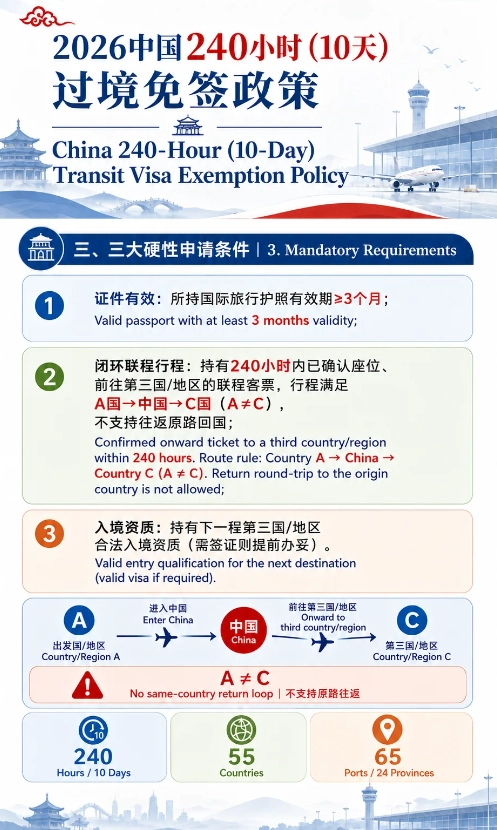
How to Apply for the 240-hour Visa-free Transit
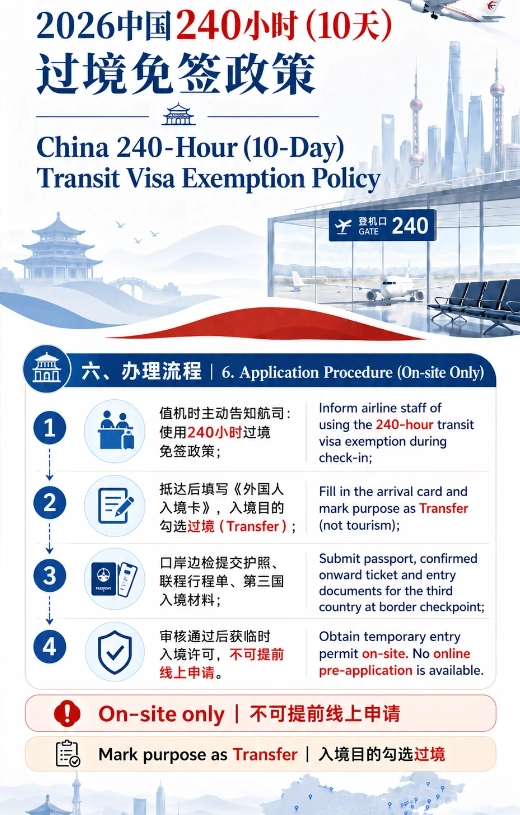
Good news: there’s no application form to fill in advance. You simply show up at the immigration counter at the designated port and request the transit visa-free entry. But you must prepare specific documents. Here is the exact checklist I give every client:
- Passport — valid for at least 6 months with at least one blank visa page.
- Confirmed onward ticket — printed or digital, showing departure to a third country within 240 hours. The ticket must have a flight number and date. A bus ticket to Hong Kong works too, but make sure it’s from a licensed operator.
- Visa for the next destination — if required. For example, US citizens don’t need a visa for Japan but do for India. Check before you go.
- Accommodation details — immigration may ask for your hotel or residence address in China. Have it ready (booking confirmation).
- Return to your home country — not needed, but some officers ask. Stay calm and show your onward ticket.
At the counter, the officer will take your fingerprints (electronic scan) and ask a few questions: “Purpose of visit?”, “Where will you stay?”, “Where are you going next?”. Answer simply and confidently. In my experience, they rarely deny if all documents are in order. However, a common issue is the officer not understanding your itinerary — so have it written in Chinese or use a translation app.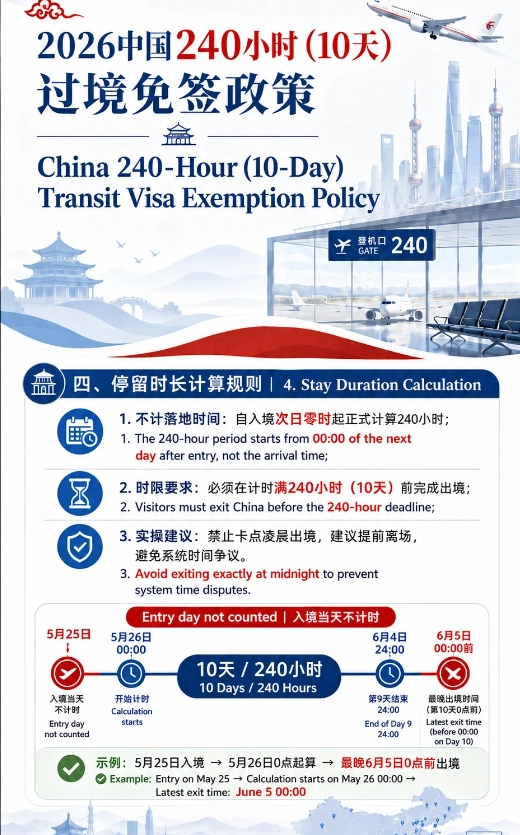
240-hour vs 144-hour: Key Differences
Many travellers still think of the “144-hour visa-free transit”. The 240-hour policy expanded the time and some regions. Here’s the breakdown:
| Feature | 240-hour (10 days) | 144-hour (6 days) |
|---|---|---|
| Duration | 10 days (240 hours from entry midnight) | 6 days (144 hours) |
| Eligible ports | 41 ports (including some land and sea ports) | Fewer ports (mainly airports) |
| Allowed area | Broader regional clusters (e.g., whole Yangtze River Delta for Shanghai) | Narrower boundaries (e.g., only certain cities) |
| Countries | Same 54 countries | Same 54 countries |
In practice, if you qualify for 240-hour, go for that — more time and flexibility. But double-check that your entry port supports 240-hour. Most major airports do, but some secondary ones still operate under 144-hour.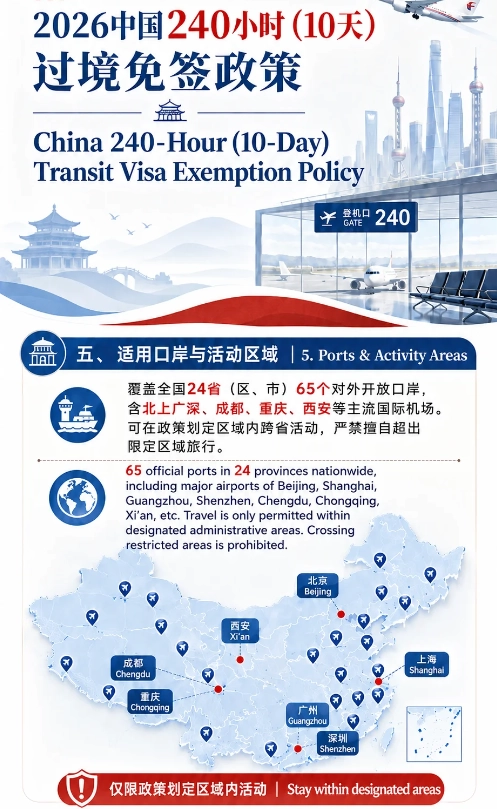
Top Mistakes Foreigners Make with the Transit Policy
I’ve seen people denied entry for small errors. Avoid these:
- Mistake #1: Overstaying the exact hour. The 240-hour countdown starts at midnight after arrival. So if you land at 3 p.m. on June 1, your allowed stay ends at midnight on June 11 (10 full calendar days). But if you land at 11 p.m. on June 1, you still have until midnight June 11. Plan your departure flight for before midnight of the last day.
- Mistake #2: Not having a ticket to a third country. You cannot use this policy to travel from one Chinese city to another, then fly home directly. You must leave China to a different country or jurisdiction. For example, Shanghai -> Beijing -> Home is not allowed. Shanghai -> Hong Kong -> Home is allowed (Hong Kong counts as a separate region).
- Mistake #3: Using Google Maps for directions inside China. It won’t work reliably. Download Apple Maps or use Baidu Maps (with English mode). But having a VPN ready is essential for accessing Google, WhatsApp, and Facebook.
- Mistake #4: Relying on cash or credit cards. China is almost cashless. You need Alipay or WeChat Pay linked to your international card. Set it up before you board — it can take a day to verify. But carry some cash (RMB) for emergencies. Not all shops accept foreign cards.






No comments yet.